Market watching, automated.
The problemTwenty sales people selling on Amazon each spent up to two hours every morning checking what had changed overnight.
My jobGive them those hours back, as product owner of a five-person team, with the sales VP as sponsor.
What I builtA tool that read Amazon every night and emailed each rep a short list of where to act. Replying was the action.
What it gaveAbout 4,000 hours a year back to the team, on several brands in six countries.
Product owner · team of 5 · 16 months · Python, scikit-learn, Selenium
Your briefing for Friday 16 October
3 signals overnight · €22.5K/wk of sales at stake · compared with Thu 15 Oct
Voltara Kettle Pro 1.7L rapid-boil, temperature control ours
50,11 € → 43,85 € €6.2K/wk at stake
Kelvio Crisp XL 6L family air fryer
95,35 € → 78,02 € Ahorra 20% €16.3K/wk at stake
Every suggested action is a reply. The code in the subject line travels back to the pipeline.
What a rep found in the inbox at 7 a.m., as the demo rebuilds it. Every brand and number is invented.
Before
Two hours of checks, every morning.
Most reps had one brand in one country. Every morning each of them pulled numbers from a dozen places to see what had changed overnight: their search rank, a rival’s price, a stock-out, a promotion.
The signal was there. Nobody had the time to read it, and nobody had written down a goal: the data science team wanted to show it could add value, the sales team wanted to invest in innovation. What I saw was twenty people doing the same boring checks by hand.
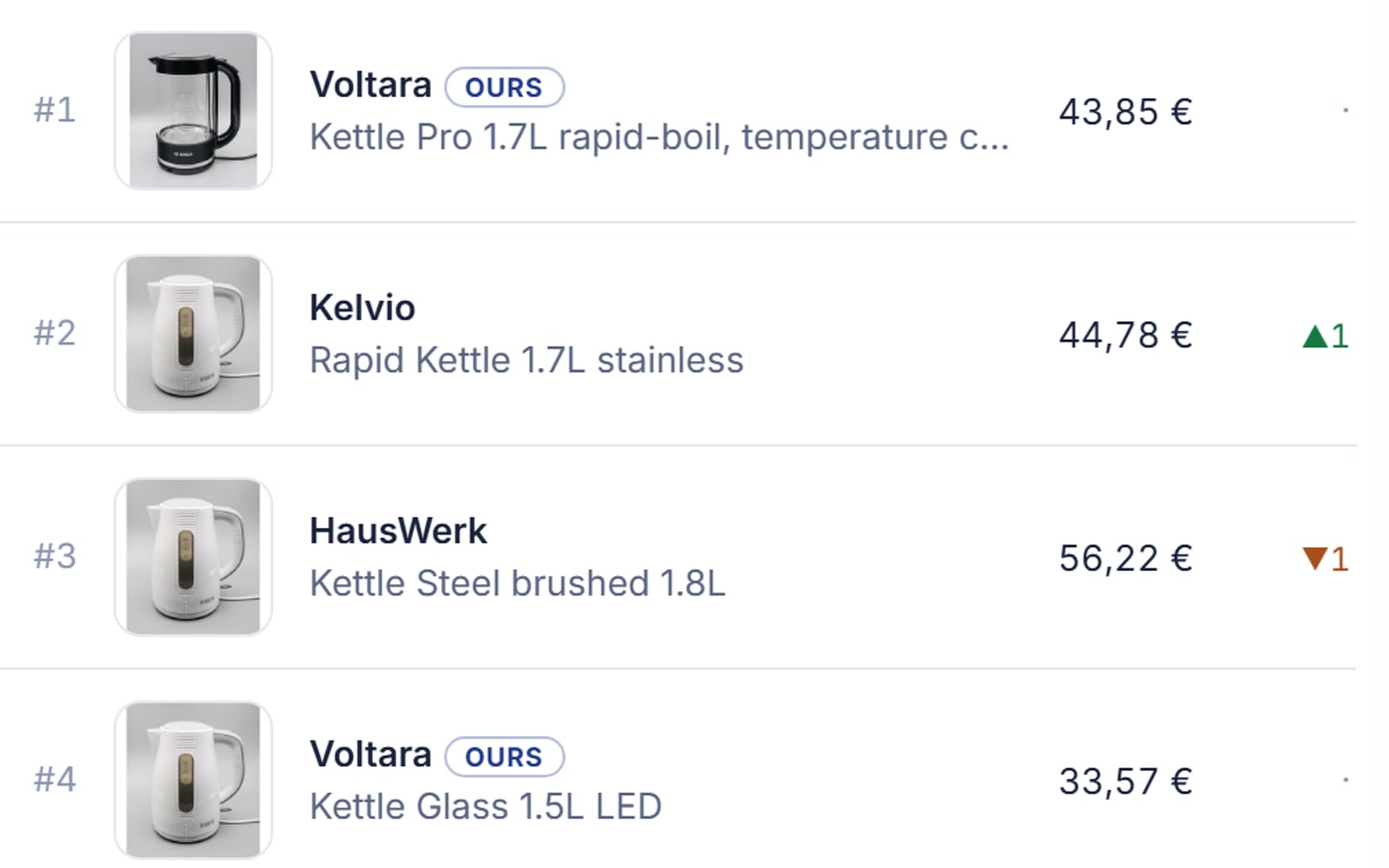
Page one for one search term, as a rep saw it each morning, term by term. (From the demo.)
Every night
While the reps slept, the tool did the checks.
At night it read Amazon’s pages with Selenium, put them next to our own sales, and flagged what had moved: a sudden price cut, a listing gone, a rival out of stock, a new promotion. Every flag was ranked by the weekly sales at stake.
The data science director asked for it, the sales VP backed it, and I ran it as product owner for the sales team with five people: a scrum master, an architect, a developer, a junior and a data analyst. Sixteen months from the first proposal to the rollout, one step at a time: first the lookup, then the noticing, then the playbook.
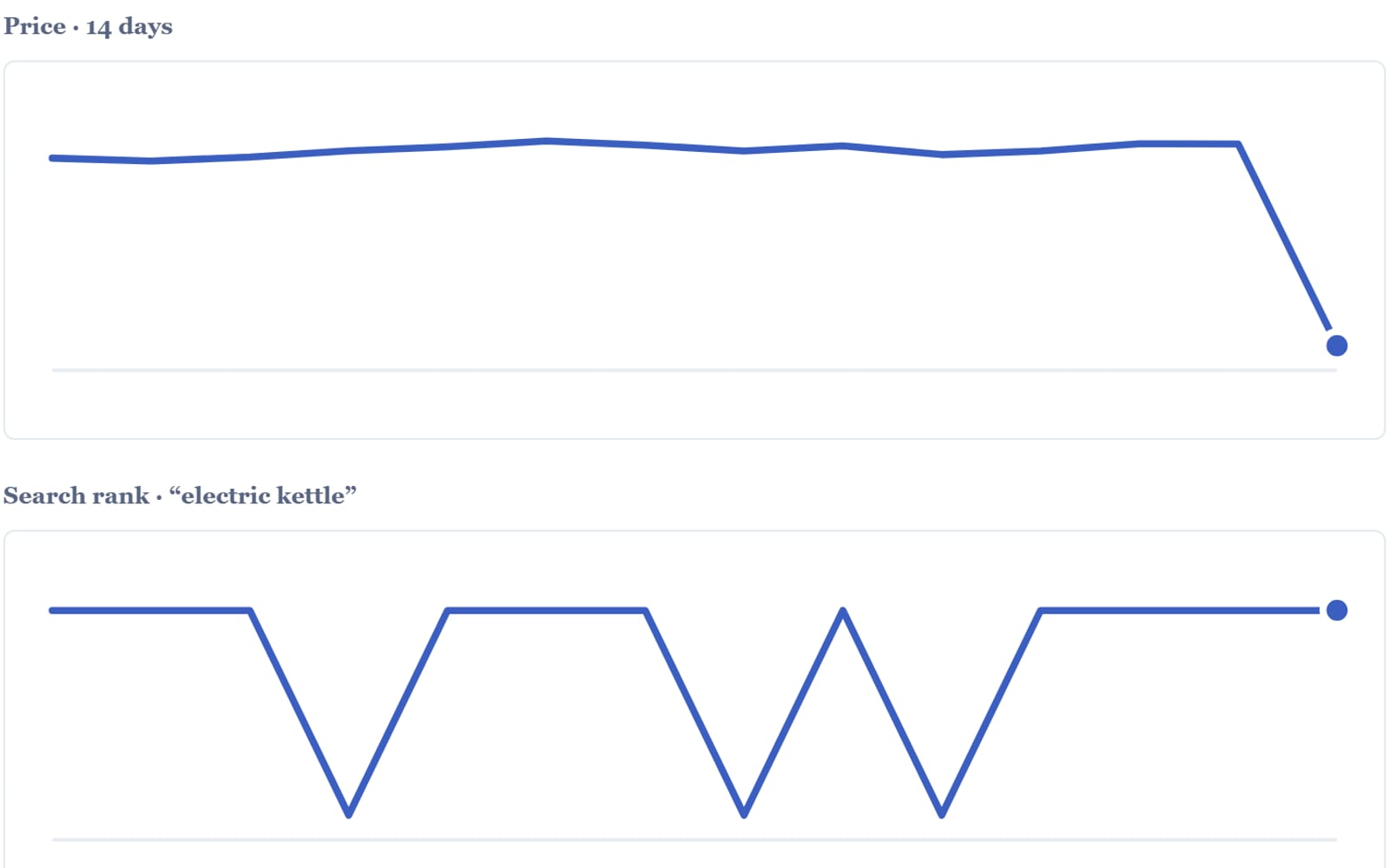
The cut it caught overnight: fourteen days of price and search rank for one product. (From the demo.)
Every morning
At 7, an email. Replying was the action.
A proper web app would have waited months for sign-off, so the interface was their inbox. Each morning a briefing: the overnight signals, ranked, each with its next step. Each step carried a code, and replying with it sent the command straight back to the pipeline.
The catch the reps valued most was the sudden price cut, which nobody in the team controlled. With the briefing in hand a rep could call Amazon the same morning and ask for the promotional label that brings the buyers in.
Your briefing for Friday 16 October
3 signals overnight · €22.5K/wk of sales at stake · compared with Thu 15 Oct
Voltara Kettle Pro 1.7L rapid-boil, temperature control ours
50,11 € → 43,85 € €6.2K/wk at stake
Every suggested action is a reply. The code in the subject line travels back to the pipeline.
The briefing as it landed, as the demo rebuilds it. Every brand and number is invented.

One reply, one command: the code in the subject line goes straight back to the pipeline. (From the demo.)
After
About 4,000 hours a year, back.
Ten hours a week each, across about twenty reps, holidays taken out: my estimate, not a stopwatch. It ran on several brands in six countries. Everyone read the briefing, the survey said; not everyone liked to say what they did with it, and some feared being replaced.
Most of the insights were folded into the company’s reporting tool, where they still live. What I would change: start from the products with known problems, and build a real web app, because email made it hard to collect the reps’ feedback.
Open the 7 a.m. briefing.
A working stand-in for the real tool. Every brand and number in it is invented.